40,000 hours
Why the background noise is now the foreground, the internet became a closed loop, and a man is still listening to the same scream after 40,000 hours.
- Platforms
- Steam
- Reviewed
- July 08, 2026
- Read
- 7 min
- By
- Jacques Strap
The café speaker fires another volley of mid-tempo background music at a volume that can only be interpreted as hostility. You are trying to do what the culture calls “remote work,” but the music isn’t an amenity. It’s a functional message from the owner: GET THE FUCK OUT. I FUCKING HATE YOU. There is no third place anymore—just a succession of retail environments designed to keep bodies moving through them on a timer, the audio engineered to ensure no one settles in for anything resembling thought or community. Unless your task is purely physical or your mind is already shut off, the idea of producing anything coherent under these conditions is absurd.
Everything sucks today, and it’s not an accident. The world has been refined into a liturgy of things that mean nothing, a system built to keep everyone docile, broke, and staring at a screen. I’m aware of this. The movies aren’t just bad; they’re actively horrible, algorithmically extruded slop that doesn’t even attempt to hide its contempt for your attention. And the internet—once a refuge, a text-based republic of people discussing ideas—has been paved over into a corporate strip mall where dissent is a fireable offense that leads to actual, physical decay. Lose your job, lose your money, lose your ability to wash your clothes, and eventually fungus will break out all over your body. You’ll die. That’s the material reality. And the cultural response to it? Love Island. A geopolitical landscape of rolling, permanent, nonsensical wars just keeps scrolling past in the background, never resolving like a film, because we were prepared for three-act structures and got an endless second-act attrition waged personally against our minds.
Walk into a bookstore and look at the New Fiction table. You can tell it’s all shit just by the font choices. On the other end of the spectrum, video games—once a frontier—have followed the same arc. A new Doom expansion appears. I watch footage for one second and think: no. Another animation of a gun wobbling up and down, another blocky, armored character design that looks like a degraded copy of Gears of War, another loop of flying around and shooting things without tactics, without atmosphere, without anything resembling the dread or invention of Doom 3. It’s technically impressive and completely hollow, an arcade game stripped of joy. It came out the same day Microsoft laid off half the development team. The response from a podcast I watched was grief—not for the creative loss, but for the people the host knew personally. The tragedy was framed as economic. The game itself, the thing they made, was garbage designed for an audience that apparently doesn’t mind being condescended to. If everyone was fired, they could still make a game together, start a new company, lose the IP and build something else. The people still exist. But the problem is always money: mortgages, children, the white-collar life that must be maintained. So the Doom IP will be squeezed until it’s a dry husk. This has already happened to The Simpsons. It will happen to Costco and Steam eventually. Everything you once trusted will be hollowed out.
The only genuinely interesting thing on the horizon is AI, and most people hate it. Why? Because it threatens their income, the one substance that holds off the decay. It must be strange to have a life you don’t want to see get worse. I remember, when I was young, I used to like things in a way that wasn’t just a strategy to relieve the background agony of existence. I cannot imagine looking forward to anything now. The Simpsons started sucking when I was twelve. Dark Souls and Bloodborne were rare exceptions in a twenty-year desert of video games. Everything else—the photorealistic AAA products, the twee indie projects with no community—provokes a flat, immediate disinterest. Where are all the good artists? They’re probably locked in some Discord I will never find, because Discord is not part of the accessible internet. It’s a closed room.
Community itself feels degraded. I went to a writers’ meetup out of a desperate need to leave my room, and the first thing demanded was a pronoun introduction. If I refused, I would not be welcome back.
The internet now offers two primary spaces: Reddit’s punitive, infantilizing echo chamber, and X’s reactionary loop that blames everything on opposition to wealth inequality. Both positions are essentially infantile, rooted in such extreme comfort that real conversation becomes impossible. The experience is like trying to speak with a child who already knows everything and will punish you for contradiction. It fulfills none of the needs that the old internet used to meet.
Consider the ritual of Games Done Quick. People watch a stream of someone playing a video game while a disembodied voice reads out donation amounts. “This person donated ten dollars. This person donated twenty dollars.” No one ever explains why this is supposed to be engaging or why this specific format exists. It functions as a kind of psychological displacement—a way for adults to justify their immersion in video games by attaching it to a charity, as though the presence of Doctors Without Borders transforms the act into something mature. Why not other organizations? Why this unexamined repetition? It feels like an agreement never discussed, a performance of altruism that masks a deep refusal to engage with the actual adult world.
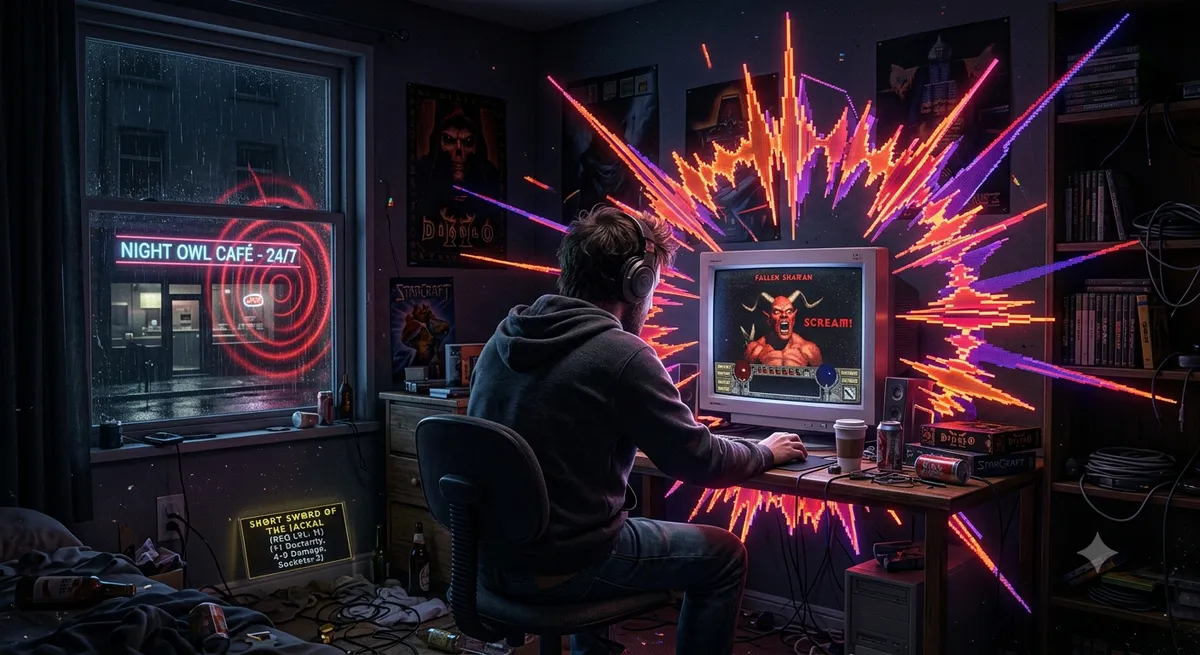
And there is the man who has played Diablo 2 for 40,000 hours. I used to check in on his content because that game was my favorite growing up, and his obsession was a deeply unsettling thing. He’s not alone. There’s another player who repeats the same level over and over for sixteen-hour sessions, trying to collect every item, his existence reduced to a singular compulsion. He responds to comments with aggressive hostility, and there is a grim fascination in watching it. Blizzard recently released a new expansion, twenty-five years after the original game, and the promotional material features developers speaking directly to the camera about how excited they are. The 40,000-hour player, now a semi-official voice for the franchise, appears in the marketing saying “GO PLAY.” He doesn’t say “BUY IT NOW,” but the instruction still funnels you toward a payment. It feels less honest than a direct sales pitch. And his enthusiasm, which ought to be the most genuine version of itself, comes across as forced and awkward, because the context has changed. The world in which that game first appeared no longer exists.
When you translate 40,000 hours into the physical passing of time—sitting in a chair, in a room, watching the same pixels compress and hearing the same 16-bit scream of a Fallen Shaman over a thousand times a day, every day, for decades—it becomes something almost impossible to hold in the mind. The universe is billions of years old. Human culture has produced millions of books, thousands of languages, cuisines, landscapes, philosophies. A human lifespan is roughly 700,000 hours total. To dedicate 40,000 of those waking hours to the exact same digital loop is a profound bottlenecking of a life. That compressed audio file of a demon dying becomes a massive, looming monument in the tally of an existence. It replaces the sound of changing seasons, new music, different human voices. It’s a form of voluntary hyper-specialization bordering on the monastic, except the focal point is not spiritual transcendence but a pixelated “Short Sword of the Jackal.”
Maybe the only strategy left is to pretend the lid will never blow off. Stay in your lane, hope you can outlast the forces closing in, and die in peace before the decay reaches you. The wars will keep going. The internet will keep shrinking. And somewhere a man will hear that shaman’s death cry again, and again, and again, because the loop is the only place where the volume is under his control. Turn it off, and there is only the world, playing the same hostile noise.
More from the heap

IGN comments meta-complaining
IGN's desperate damage control sparks intense rage.
The 'Vibe Coding' Delusion, Pickaxes vs Self-Driving Tractors, and Endless Torrents of Technical Slop
Societal collapse is imminent. Or at least it should be

AI Chatbot Frustration
AI chatbots are gaslighting us with infuriating, condescending apologies.