Hololive / Geek Jack / The Holocast Stream
An analysis of how the multi-million-dollar VTuber industry commercializes human isolation by transforming profound loneliness into a highly profitable, corporate-engineered simulation of intimacy.
- Platforms
- Steam
- Reviewed
- July 12, 2026
- Read
- 6 min
- By
- Jacques Strap
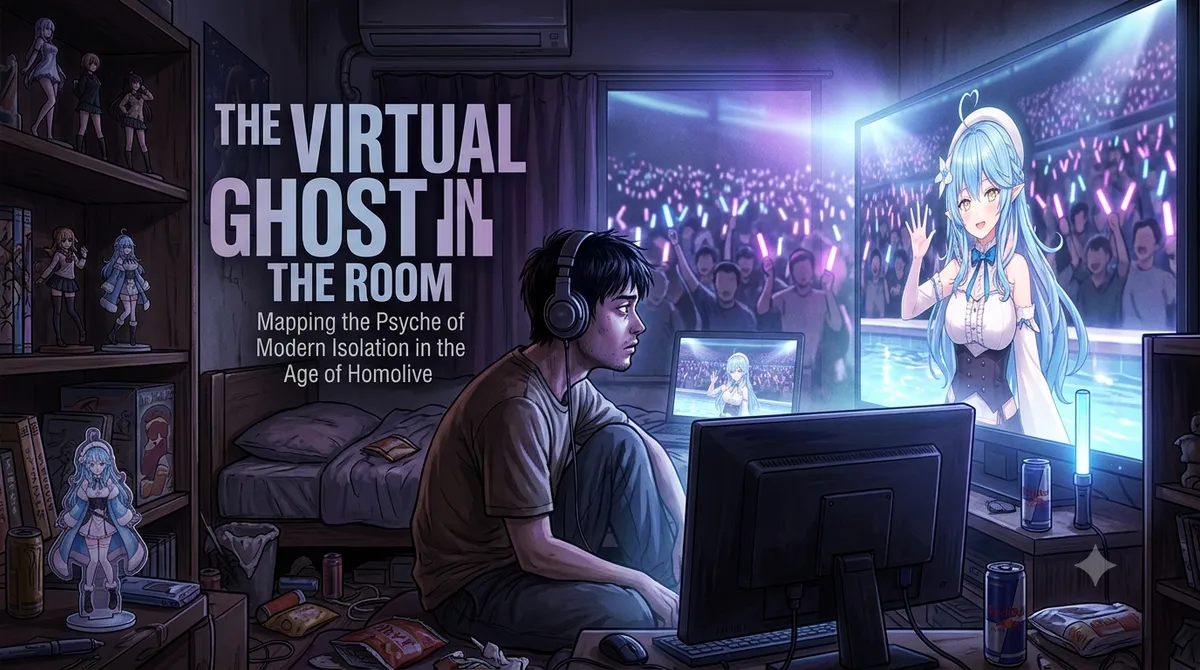
I went looking for something and I found this, a whole world tucked inside the glowing rectangle, and now I can’t unsee it, the whole sad, humming apparatus of it, the names like bad jokes told by a dead god—Homolive, Holocast, Geek Jack—and underneath the dumb corporate word-slop there’s a whole economy of loneliness, a machine that runs on the soft, desperate hum of men who have given up on the real, and the machine just keeps spinning, day after day, selling them whispers and jpegs and the ghost of a girlfriend’s voice in a dark room, and I swear to you I felt something break inside my chest just looking at it.
It’s the year twenty-twenty-something and they call the thing Holocast now—an official term, you understand, a branded term, like Podcast or Broadcast, only it sounds exactly like the worst thing that ever happened, and nobody in the marketing meeting noticed because the language gap is a canyon and nobody cares, they just sail the word right past the charnel house of history and into a multimedia project about magical girls who stream on a fictional app, and I thought: that’s it, that’s the whole sickness in one syllable, the total obliviousness, the grinding of gears that turns memory into product, and I wanted to throw my laptop out the window but I didn’t, I just kept scrolling, because something horrible and magnetic was pulling me deeper.
And then there’s the store—they call it Geek Jack—and for a minute I thought they meant hijack, like they’re jacking money from the pockets of shut-ins, but no, the thing is named after the act itself, the solitary act, the thing these men do in the blue light of their screens while the voice actress breathes into a binaural microphone and pretends to share a drink with them, and that’s the product, a voice pack called “Night Pool Date with Lamy,” a downloadable file where a cartoon girl roleplays an intimate evening with you, just you, and the company sells this, they list it next to the acrylic stands and the life-sized wall tapestries, they sell the fantasy of being loved without ever having to exist in a body, without ever having to risk a single true word spoken to another human face, and reading the product description I felt something curdle in my stomach, a kind of existential nausea, because I could see the room, I could see the man alone in the dark with his headphones on, and I wanted to cry for him and scream at him in the same breath, and the worst part is the company just adds another line to the spreadsheet, Q3 merchandise, moving units, the stock price holding steady.
I watched some of the streams, the so-called talent, and I’m telling you now there is nothing there, nothing at all, just a girl with a baby voice making noises that pass for conversation, and the chat scrolls by in a blur of hearts and dollar signs, and every donation is a little electric jolt of validation that tells her she’s a genius, she’s a star, she’s saving lives, when really all she’s doing is sitting in a room and being a blank screen onto which thousands of hollow men project their hunger, and the whole thing is a feedback loop of mediocrity, the blind leading the blind into a ditch full of merchandise, and every time I heard that high-pitched giggle I thought: a normal person would say “that’s not funny,” a normal person would tell you to knock it off, but there are no normal people here, the normal people have been exiled, they’ve been muted, they’ve been replaced by bots and mods and the algorithmic hum of an echo chamber that tells you you’re perfect, you’re wonderful, now please open your wallet for the next voice pack.
The audience is men, just men, eighty percent, ninety percent, a sea of male bodies packed into a concert hall waving light sticks in frantic synchronized patterns at a giant screen, and I looked at those faces, the expressions of ecstatic surrender, and I felt a profound horror, not the horror of a monster movie but the horror of watching the human spirit flicker and die, a room full of people who have traded the terrifying risk of real intimacy for a neon-lit tomb where everyone else is already dead in the same way, and they’re not even connecting with each other, they’re all just alone together, islands of isolation wired into the same signal, and the signal is a corporate product, a streaming app with a name that sounds like genocide, and the whole room shudders in time, a cult without a god, a religion of the void.
I tried to find someone, any living person in Japan, who would stand up and say this is disgusting, this is a spiritual poison, but the politicians are silent, they’ve traded their souls for GDP, they call this Cool Japan and slap it on tourism brochures, and the old men in the Diet don’t even know what a VTuber is, they just see the tax revenue and nod, and I thought of Mishima, the ghost of Mishima, that man of iron and flesh, who screamed at a post-war Japan that had become empty and sterile and wealthy, and I knew exactly what he would say, he would say this is the final victory of the American consumer cancer, a Japan that has given up the body entirely, that has replaced the beauty of the sword and the skin and the sweat with a digital cartoon that asks for nothing but your credit card number, a whole nation of young men walking willingly into a comfortable grave, and Mishima would have torn it down with his bare hands, but Mishima is dead, and the streams keep running, and the voice packs keep selling, and the light sticks keep waving in the dark.
And the cruelty of it, the absolute bottomless cruelty, is that the dysfunction isn’t a bug, it’s the product. The alienation, the disgust of the outside world, the way a normal person looks at this and feels sick—that’s the point. That’s the draw. The fans wrap themselves in the revulsion like a blanket, they say to the world “you think we’re pathetic? Watch us be the most pathetic thing you’ve ever seen, and there’s nothing you can do about it,” and the company stands behind them and collects the rent on their spite, and the cycle spins deeper, more isolated, more hateful, a closed loop of negativity that feeds on itself and grows fat.
I think about the man who buys the “Night Pool Date” audio, who puts on his headphones and closes his eyes and tries to feel something that isn’t the ache of his own emptiness, and I think about the executives who greenlit the name Holocast, who never once said the word aloud to an English speaker, and I think about the thousands of men in the concert hall, synchronized, ecstatic, utterly lost, and I realize that this is not a subculture, it’s a symptom of a world that has run out of meaning and decided to sell the void back to us by the month, a digital fever dream where the only thing worse than the loneliness is the cure.
I’ve seen enough. The score is zero, absolute zero, a black hole where the light of actual human connection goes to die, a nameless, numberless, un-rateable nothing, and I’m going to go outside now and try to remember what a real voice sounds like.
More from the heap
40,000 hours
Why the background noise is now the foreground, the internet became a closed loop, and a man is still listening to the same scream after 40,000 hours.

IGN comments meta-complaining
IGN's desperate damage control sparks intense rage.
Weird Meetup hell
Things that are open to the public invite mental illness and stupidity